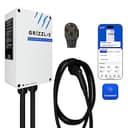
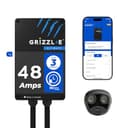
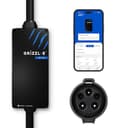
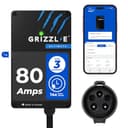
Every live Grizzl-E, by the published figures
One table, four chargers, no numbers of ours in it. Every cell is read from United Chargers’ own specification table for that model, or from the ENERGY STAR certified-product record where one exists.
| Model | Max output | Adjustable current | Install | Connector | Cable | ENERGY STAR |
|---|
| Classic Connect | 40 A, 10 kW | 40 A down to 16 A | NEMA 14-50 plug | J1772 or NACS | 25 ft | Not listed |
| Ultimate 48A | 48 A, 11.52 kW | 40, 32, 24 or 16 A | Hardwired only | J1772 or NACS | 24 ft (certifier’s figure) | Yes — GRS-077-W-HW-25J48-A-GB |
| Mini | 40 A, 9.6 kW | 40 A down to 7 A | NEMA 14-50 plug, four adapters in the box | J1772 | 24–25 ft | Not listed |
| Ultimate 80A | 80 A, 19.2 kW | 80, 64, 56, 48, 40, 32, 24 or 16 A | Hardwired only | J1772 or NACS | 25 ft | Listed on the manufacturer’s own spec table |
Two cells there deserve a footnote rather than a shrug. The Mini’s cable is published as 25 feet on United Chargers’ own page and 24 feet on the Amazon listing we link, and we have no way to resolve a one-foot disagreement without owning one, so both figures stay on the page. And the Ultimate 48A’s 24-foot cord is the certifier’s measured figure from the ENERGY STAR record, which is the more rigorous of the two numbers published for that unit.
How to choose between the four
You want one charger and no electrician: the Classic Connect. It plugs into a NEMA 14-50 outlet, which is the same outlet an electric range or an RV pedestal uses, so if you already have one the install is an afternoon. You get the cast-aluminum Type 4 case, the published cold-weather floor, 25 feet of cable and 2.4 GHz Wi-Fi with the Grizzl-E Connect app. Cons that matter: 40 amps is a hard ceiling because of the plug, scheduling now runs through an account rather than on the unit itself, and this model is not on the ENERGY STAR list even though the older no-app Classic was. Full detail in our Grizzl-E Classic review.
You drive a Tesla and are hiring an electrician anyway: the Ultimate 48A. Same body, ceiling raised to 48 amps and 11.52 kW, an OCPP radio on top of the Grizzl-E app — genuinely rare on home hardware — and the one certification in this lineup you can quote by model number to a rebate clerk. Cons, and the first decides it for most readers: the live Amazon SKU is the NACS-cable build, so a J1772 car needs an adapter permanently in the chain. It is also hardwire-only, so it stays with the house, and 48 amps needs a dedicated 60-amp circuit an older panel may not have. See the Ultimate review and Classic versus Ultimate.
You are not sure which outlet you will use: the Mini. It ships on a 14-50 plug with 14-30P, 6-50P, TT-30P and 5-15P adapters in the box from United Chargers rather than as third-party add-ons, and the manufacturer publishes its output as adjustable from 40 amps all the way down to 7 — the lowest floor in the lineup. So it runs on the dryer circuit today and at full speed the day a 14-50 is fitted, and it travels. Cons: it ships set to 40 amps and United Chargers’ own Mini manual says the charger cannot detect a circuit’s limit, so turning it down before the first session is your job; setting the hardware cap means taking the front cover off; and on a dryer circuit you are paying for capacity you will never use. Our Mini review is blunt about that trade, and Mini versus Classic puts them side by side.
You have a 400-amp service and want 19.2 kW: the Ultimate 80A. Eighty amps, 19.2 kW, the widest selectable range in the lineup (eight steps from 80 down to 16), OCPP, and the same Type 4 cast enclosure. It is the only unit here that can meaningfully out-charge a 48-amp charger. Cons, and they are large: 80 amps requires a dedicated 100-amp circuit, which in practice means a service upgrade for most US homes and often a five-figure electrical bill, and almost no car sold today has an onboard AC charger that can accept 19.2 kW — so the extra capacity sits idle. Read our 80-amp page before you spend the money, and onboard charger limits to see where your own car caps out.
What a Grizzl-E costs to run at each setting
A charger may draw 80 percent of its circuit’s rating continuously, which is why the selectable current range is the most useful spec on the table above. At our 3.5 miles-per-kWh reference:
| Setting | Circuit needed | Power | Range per hour | Across a 10-hour night |
|---|
| 16 A | 20 A | 3.84 kW | ~13 miles | ~130 miles |
| 24 A | 30 A (dryer circuit) | 5.76 kW | ~20 miles | ~200 miles |
| 40 A | 50 A (NEMA 14-50) | 9.6 kW | ~34 miles | ~340 miles |
| 48 A | 60 A, hardwired | 11.52 kW | ~40 miles | ~400 miles |
| 80 A | 100 A, hardwired | 19.2 kW | ~67 miles | ~670 miles |
Every row from 24 amps down covers a normal day of US driving, which is the reason we rank the cheaper plug-in Classic above the hardwired units for most readers. Our how many amps do I need guide sizes this from your own mileage, and installation cost prices the circuit, which at this end of the market is usually the larger half of the bill.
Two Grizzl-E products we did not rank, and why
The original no-app Grizzl-E Classic. The Classic that carried an ENERGY STAR listing and no radio at all has been superseded on Amazon by the Classic Connect, which adds Wi-Fi and is not on the certified list. We rank what is buyable, so the Connect is what appears above — but if a rebate form in front of you names ENERGY STAR, that substitution is the single most important thing on this page. The Ultimate 48A is the certified route, or see certified chargers under $500.
The NACS cable builds of the Classic and the 80A. United Chargers offers a NACS output cable as an option on both, but the Amazon listings we link and price-check are the J1772 builds, and we will not rank a configuration we cannot link to a live listing. For a Tesla the Ultimate 48A above is the NACS SKU; otherwise a J1772-to-Tesla adapter costs well under $50 and does the same job.