What you are actually buying at each level
The table below is specifications, not prices — the live number for each unit is on its buy button above, stamped with the date of the check. Read it as the denominator in the cost-per-amp calculation: the more of these boxes a charger ticks at a given amperage, the better the value.
| Charger | Max current | Adjustable | Install | Cable | ENERGY STAR | Warranty |
|---|
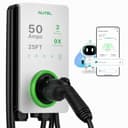
| Autel MaxiCharger Home | 50 A / 12 kW | 16–50 A | Hardwired, 70 A circuit for full output | 25 ft | Yes | 3 years |
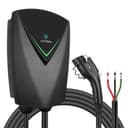
| Lectron Nexus J1772 | 48 A / 11.5 kW | Not published | Hardwired, 60 A circuit | 23 ft | Yes | 3 years |
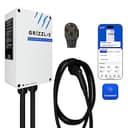
| Grizzl-E Classic Connect | 40 A / 10 kW | 40 A down to 16 A | NEMA 14-50 plug | 25 ft | Not listed | 3 or 5-year option |
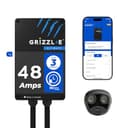
| Grizzl-E Ultimate 48A | 48 A / 11.52 kW | 40 / 32 / 24 / 16 A | Hardwired, 60 A circuit | 24 ft (certifier’s figure) | Yes | 3 or 5-year option |
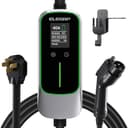
| ELEGRP 40A | 40 A / 9.6 kW | 16 / 20 / 24 / 32 / 40 A | NEMA 14-50 plug | 25 ft | Not listed | Up to 2 years |
Two lines there do most of the work. The ENERGY STAR column is not a performance claim — it is a standby-power certification — but some utility rebate programs name it in writing, and a $100 rebate changes the cost-per-amp arithmetic more than any discount in this market. EV charger rebates and tax credits explains where that requirement usually hides. And the “adjustable” column is the one that decides whether the amperage you paid for is amperage you can use.
The hidden half of the bill
A charger is rarely the biggest line on an EV charging invoice. The circuit is. A 60-amp hardwired run to a garage wall usually costs more than the 48-amp charger on the end of it, and a 70-amp circuit for a 50-amp charger costs more again — which is why the best-value answer for a household with a 100-amp panel can be a 40-amp plug-in on an outlet that already exists. Work the whole number, not the charger:
| Route | What it needs | Power delivered | Where the money goes |
|---|
| Plug-in on an existing NEMA 14-50 | Nothing, if the outlet is dedicated | 9.6 kW | All of it into the charger |
| Plug-in on a new NEMA 14-50 | Outlet, 50 A circuit, permit | 9.6 kW | Mostly the circuit |
| Hardwired 48 A | 60 A dedicated circuit, permit | 11.52 kW | Mostly the circuit |
| Hardwired 50 A | 70 A dedicated circuit, often a panel review | 12 kW | The circuit, and possibly the panel |
The second and third rows are closer in price than most buyers expect, which is the single most useful thing on this page: if an electrician is coming anyway, hardwiring 48 amps often costs little more than fitting an outlet for 40. Our installation cost guide has real figures, and hardwired versus plug-in weighs the rest of the trade.
How to choose between the picks
Best value overall: the Autel MaxiCharger Home. Fifty amps and 12 kW with the output adjustable from 16, a 25-foot J1772 cable, IP65 / NEMA 4X, the widest published temperature range on this page at −40°F to 131°F, a three-year warranty, ENERGY STAR, and app, AutoStart and RFID-card authentication. On cost per amp it beats units with fewer features at lower prices. Cons: hardwired, so there is an electrician in the story; the full 50 amps needs a 70-amp circuit; RFID cards are sold separately; and its adaptive load management requires extra hardware Autel does not include. Our MaxiCharger review has the detail.
Best value at 48 amps, with no app: the Lectron Nexus J1772. Forty-eight amps and 11.5 kW hardwired, an IP66 indoor/outdoor rating, a 23-foot cable with a wall-mount J-hook and plug holder, ETL listing to UL 2594 / UL 2231 / UL 2251, FCC, ENERGY STAR, and a three-year warranty — with no Wi-Fi, no app and no account anywhere on the product. For anyone who resents paying for software, this is the value answer, and it appears on the certifier’s own list twice, once with a radio and once without. Cons: Lectron publishes no selectable current range for it, so it needs a 60-amp circuit or nothing. See chargers without Wi-Fi.
Best value plug-in: the Grizzl-E Classic Connect. Forty amps on a NEMA 14-50 plug, cast aluminum, UL Type 4, published from −22°F to 122°F, 25 feet of cable, Wi-Fi scheduling, and adjustable 40 down to 16 — the cheapest route to a metal-cased charger that needs no hardwiring. Cons: 40 amps is its ceiling because of the plug, scheduling runs through an account, and it is not on the ENERGY STAR list even though the older no-app Classic was.
Best value for a Tesla: the Grizzl-E Ultimate 48A. A genuine 48 amps with a native NACS cable, the same cast enclosure and cold-weather floor, OCPP on top of the Grizzl-E app, and an ENERGY STAR certification recorded under model GRS-077-W-HW-25J48-A-GB — a combination that normally costs considerably more. Cons: the Amazon SKU is the NACS cable, so a non-Tesla needs an adapter permanently in the chain, and it is hardwire-only.
Best budget pick: the ELEGRP 40A. The cheapest real 40 amps we can price, with five on-unit current levels from 16 to 40, an IP67 station body published to −21°F, a 25-foot cable, a delay timer, a carrying case and ETL certification. Cons: no app, no energy monitoring, no ENERGY STAR, and the IP67 figure covers the station rather than the connector — ELEGRP publishes IP54 for that.
And where paying more is the value answer
Cost per amp is the right lens for most buyers and the wrong one for three specific households: a panel with no spare capacity, where a load-managing charger can delete a service upgrade worth several chargers; a wall too narrow for a normal body, where a smaller unit shortens the 240-volt run that is the real expense; and the rare car whose onboard charger can accept more than 48 amps. In those three cases the expensive charger is the cheap answer, and best premium EV chargers works through each one — including the honest conclusion that outside them, the premium buys no extra range per hour at all.
Where value stops being value
Two traps, both common. The first is buying amperage your car cannot accept: AC charging is limited by the vehicle’s onboard charger, and most mainstream EVs cap around 11 kW, so paying for 50 amps when you will only ever draw 48 is spending for nothing — onboard charger limits shows how to check yours. The second is buying a charger with no named safety listing because it was $40 cheaper. A home charger is a continuous 240-volt load living on a garage wall for a decade; the listing is the cheapest part of it. If the budget is genuinely tight, the right move is a cheaper listed charger at a lower amperage, not an unlisted one — see best 16-amp chargers for the smallest honest install.